
Ramayana Timeline: Events from Birth of Rama to His Return to Ayodhya
The epic of the Ramayana is one of the most influential and sacred texts in Indian civilization. Traditionally attributed to the sage Valmiki, the Ramayana narrates the life of Rama, the seventh incarnation of Vishnu. The epic tells a powerful story of righteousness (dharma), devotion, sacrifice, and the eternal triumph of good over evil.
The narrative begins in the prosperous kingdom of Ayodhya, ruled by King Dasharatha, and follows Rama’s life journey-from his miraculous birth to his triumphant return to Ayodhya after defeating the demon king Ravana.
This blog presents a chronological timeline of the Ramayana, covering the key events from the birth of Rama to his return after fourteen years of exile.
The Divine Purpose Behind Rama’s Birth
Before the birth of Rama, the world was suffering under the tyranny of Ravana, the powerful ruler of Lanka. Ravana had obtained powerful boons from the gods, making him nearly invincible. His arrogance and cruelty spread fear across the heavens and the earth.
Unable to defeat him directly, the gods approached Vishnu for help. Vishnu promised to incarnate on Earth as a human prince who would ultimately defeat Ravana and restore cosmic balance.
This divine plan set the stage for the birth of Rama in the royal family of Ayodhya.
Birth of Rama and His Brothers
King Dasharatha had three queens: Kaushalya, Kaikeyi, and Sumitra. Despite ruling a prosperous kingdom, Dasharatha had no children and worried about the future of his dynasty.
To solve this problem, he performed the sacred Putrakameshti Yajna, a special ritual meant to grant children. The gods blessed the ritual, and a divine offering emerged from the sacrificial fire.
The queens consumed the sacred offering, and soon they gave birth to four sons:
- Rama (born to Kaushalya)
- Bharata (born to Kaikeyi)
- Lakshmana (born to Sumitra)
- Shatrughna (also born to Sumitra)
Among them, Rama was the eldest and most virtuous. From childhood, he demonstrated extraordinary wisdom, discipline, humility, and compassion.
Lakshmana developed an especially deep bond with Rama and remained inseparable from him throughout his life.
Childhood and Education of the Princes
The four princes grew up in the royal palace of Ayodhya and received the finest education. They were trained in:
- Scriptures and philosophy
- Ethics and governance
- Martial arts and archery
- Spiritual discipline
Their teachers were revered sages who instructed them in the principles of dharma and righteous leadership.
Rama excelled in every discipline. His calm nature, respect for elders, and sense of justice earned him admiration across the kingdom.
Lakshmana remained constantly by Rama’s side, serving him with loyalty and devotion.
Sage Vishwamitra Takes Rama and Lakshmana to the Forest
One day, the great sage Vishwamitra visited King Dasharatha’s court. His sacred rituals in the forest were being disturbed by demons.
Vishwamitra requested that Rama accompany him to protect the yajna. Although Dasharatha hesitated to send his young son, the sage assured him that Rama was destined for greatness.
Rama and Lakshmana followed Vishwamitra into the forest, marking their first step into the wider world.
During this journey, Rama:
- Defeated the demoness Tataka
- Protected the sage’s sacrifices
- Learned powerful celestial weapons
These events revealed Rama’s divine strength and courage.
Rama Breaks Shiva’s Bow and Marries Sita
After completing the forest mission, Vishwamitra took the princes to the kingdom of Mithila, ruled by King Janaka.
Janaka had announced a grand Swayamvara for his daughter Sita. The challenge was extraordinary: any suitor wishing to marry Sita had to lift and string the divine bow of Lord Shiva.
Many kings attempted the challenge but failed.
When Rama approached the bow, he lifted it effortlessly. As he attempted to string it, the bow broke with a thunderous sound.
This miraculous feat amazed everyone present, and Sita chose Rama as her husband.
Soon after:
- Rama married Sita
- Bharata married Mandavi
- Lakshmana married Urmila
- Shatrughna married Shrutakirti
The princes returned to Ayodhya with their brides.
Dasharatha Announces Rama as Crown Prince
Years later, King Dasharatha decided that the time had come to crown Rama as the heir to the throne. The people of Ayodhya celebrated the decision with joy.
Rama was beloved by the citizens for his humility, fairness, and compassion.
However, fate had other plans.
Read Also : Lakshmana’s Loyalty: The Ideal Brother in Ramayana
Kaikeyi’s Two Boons Change the Course of History
Queen Kaikeyi’s maid Manthara feared that Kaikeyi would lose influence if Rama became king. She manipulated Kaikeyi into claiming two boons that Dasharatha had once promised her.
Kaikeyi demanded:
- Bharata should become king
- Rama should be exiled to the forest for 14 years
Dasharatha was devastated but bound by his promise.
Rama accepted the exile without protest, believing it was his duty to honor his father’s word.
Rama, Sita, and Lakshmana Leave for Exile
Despite Rama’s attempts to persuade her otherwise, Sita insisted on accompanying him. Lakshmana also chose to join his brother.
The three left Ayodhya wearing simple forest garments.
Their departure filled the city with grief. Citizens followed them for miles, unwilling to let their beloved prince go.
Eventually, Rama persuaded them to return.
Life in the Forest
During their exile, Rama, Sita, and Lakshmana traveled through many forests and hermitages.
They met sages and protected them from demons. Their life was simple yet peaceful.
Eventually they settled in Panchavati, near the Godavari River.
Here, the events that would change their destiny began to unfold.
Surpanakha’s Insult and the Conflict with Ravana
One day, Ravana’s sister Surpanakha encountered Rama and was captivated by his beauty.
When Rama rejected her advances, she attacked Sita in jealousy.
Lakshmana intervened and cut off her nose and ears.
Humiliated, Surpanakha sought revenge and told Ravana about Sita’s extraordinary beauty.
Ravana became obsessed with possessing Sita.
The Golden Deer and Sita’s Abduction
Ravana devised a cunning plan.
His ally Maricha transformed into a magical golden deer to lure Rama away.
Sita asked Rama to capture the deer. When Rama pursued it, Maricha cried out in Rama’s voice as he died.
Believing Rama was in danger, Sita insisted that Lakshmana go help him.
When Lakshmana left, Ravana appeared disguised as a monk and kidnapped Sita.
He carried her away to Lanka in his flying chariot.
Rama’s Search for Sita
When Rama returned and discovered Sita was missing, he was devastated.
He began a desperate search for her across forests and mountains.
During this journey he met:
- Hanuman
- Sugriva
Hanuman quickly became Rama’s most devoted follower.
Alliance with Sugriva
Sugriva had been exiled by his brother Vali.
Rama agreed to help Sugriva regain his kingdom. In return, Sugriva promised to help find Sita.
Rama defeated Vali in battle, restoring Sugriva as king of the vanaras.
Sugriva then sent search parties in all directions.
Hanuman Discovers Sita in Lanka
Hanuman eventually reached Lanka after an incredible leap across the ocean.
There he found Sita imprisoned in the Ashoka Vatika garden.
He delivered Rama’s ring to reassure her and promised that Rama would soon rescue her.
Before leaving, Hanuman destroyed parts of Lanka and allowed himself to be captured so he could deliver a warning to Ravana.
Ravana ordered his tail to be set on fire—but Hanuman used the flames to burn large parts of the city before escaping.
The Bridge to Lanka
Rama gathered a massive army of vanaras and bears.
Under the guidance of the engineer Nala, they constructed a legendary bridge across the ocean known as Rama Setu.
The army crossed into Lanka to begin the final battle.
The Great War in Lanka
The battle between Rama’s forces and Ravana’s army was fierce and legendary.
Many powerful warriors fought on both sides, including:
- Kumbhakarna
- Indrajit
Lakshmana eventually defeated Indrajit in battle.
After many intense confrontations, Rama finally faced Ravana in a climactic duel.
Using the divine Brahmastra weapon, Rama defeated Ravana and restored justice.
Sita’s Trial by Fire
After Ravana’s defeat, Sita was reunited with Rama.
However, to prove her purity after captivity, she underwent the Agni Pariksha, a trial by fire.
The fire god confirmed her innocence, and Rama accepted her once again.
The Return to Ayodhya
With the exile period complete, Rama, Sita, and Lakshmana prepared to return home.
They traveled in the celestial Pushpaka Vimana, Ravana’s magical flying chariot.
Back in Ayodhya, Bharata had refused to sit on the throne and ruled only as Rama’s representative.
When Rama returned, the entire city celebrated with lamps and joy.
This celebration is believed to be the origin of the festival Diwali.
Rama’s Coronation
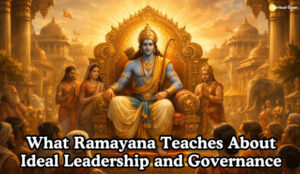
Rama was crowned king of Ayodhya in a grand ceremony known as Rama Pattabhisheka.
His reign became known as Rama Rajya, a golden age of justice, prosperity, and harmony.
Under Rama’s rule:
- Dharma flourished
- People lived peacefully
- Justice prevailed
The timeline of the Ramayana-from Rama’s divine birth to his triumphant return to Ayodhya-is far more than a mythological story. It is a profound spiritual journey that teaches the timeless values of duty, loyalty, courage, and righteousness.
Rama’s life shows that even the most powerful individuals must face hardship, but through adherence to dharma and faith in the divine, good ultimately prevails over evil.
For thousands of years, the story of Rama has inspired countless generations and continues to remain one of the greatest epics ever written.
Read More : Unknown Facts About Ramayana You Never Heard Before